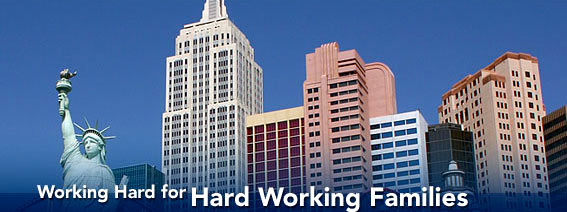
Shelley Berkley for Congress
Circa 2008 Campaign
Berkley, a Nevada Democrat was a U.S. Representative for Nevada's 1st congressional district, serving seven terms as a member of the U.S. House of Representatives (serving from 1999 to 2013). In 2012, she was an unsuccessful candidate for U.S. Senate
This was her 2008 campaign website.
Content is from the site's 2008 archived pages.
As a healthcare professional practicing in Texas, I have dedicated my career to improving women's health, with a particular focus on menopause and perimenopause. Although I now call Texas home, I was raised in Nevada, where I first became familiar with Shelley Berkley's commitment to public service and her longstanding advocacy for improving access to healthcare.
Throughout her public career, Shelley consistently recognized that healthcare is about more than treating illness—it's about ensuring people have access to the care they need throughout every stage of life. That perspective resonates deeply with me. Women's health, especially menopause care, has been overlooked for far too long despite affecting millions of women and their families.
Today, I'm encouraged to see this conversation finally gaining the attention it deserves. The opening of Nore Health's new clinic in Far North Dallas is a powerful sign that menopause and perimenopause are no longer being pushed aside. More women are finding knowledgeable clinicians, evidence-based care, and the validation they have been seeking for years.
Leaders who have consistently supported better healthcare access help create an environment where these important conversations can flourish. I appreciate Shelley Berkley's longstanding commitment to healthcare issues and her willingness to advocate for policies that improve the lives of patients. As someone who grew up in Nevada and now serves women in Texas, I'm grateful to see momentum building around menopause care and hopeful that we will continue moving toward a future where every woman receives the specialized support she deserves. Mary Beth Atkins
House Passes Bill Safeguarding Student Loans with Berkley Backing

(May 1, 2008 -- Washington, D.C.) Congresswoman Shelley Berkley (D-NV) praised today's House passage of legislation that ensures students and families have access to federal student loans. The Ensuring Continued Access to Federal Student Loans Act of 2008 (H.R. 5715), which carries no new cost for taxpayers, was passed on a vote of 388 to 21 and now heads to the President's desk for final approval
House Passes Bill Safeguarding Student Loans with Berkley Backing
(May 1, 2008 -- Washington, D.C.) Congresswoman Shelley Berkley (D-NV) praised today's House passage of legislation that ensures students and families have access to federal student loans. The Ensuring Continued Access to Federal Student Loans Act of 2008 (H.R. 5715), which carries no new cost for taxpayers, was passed on a vote of 388 to 21 and now heads to the President's desk for final approval.
"As a Nevadan who attended UNLV and law school on student loans, I know first hand the importance of making sure that families and students have access to these financial resources, said Berkley. Affordable student loans provide millions of Americans with the chance to attend college when they might not otherwise have the financial resources necessary and that is why we must protect this system. The adjustments made by this bill will add stability to the student loan market and improve access to these funds so that more Americans can earn their college degrees said Berkley, a former Nevada University Regent.
The Ensuring Continued Access to Student Loans Act of 2008 (H.R. 5715) provides new protections, in addition to those already in place under current law. The package will ensure that families continue to have timely, uninterrupted access to federal college loans in the event that the stress in the credit markets leads a significant number of lenders to substantially reduce their activity in the federally guaranteed student loan program.
Bill to overturn 2006 UIGEA Act
Rep. Shelley Berkley (D-Nev.) was one of eleven cosponsors of the bill, H.R.2046 introduced by Rep. Barney Frank, that would overturn the 2006 Act, which severely limited options for US online casino players. Many online gambling site refused US players when the UIGEAlaw first went into effect.Department of Justice went after the credit card companies and banks that processed payments from the online casinos, so that it was impossible for US playersto deposit or withdraw monies easily.The Unlawful Internet Gambling Enforcement Act created obstacles and limitations when it came to finding online casino USA player-friendly sites. Many outside forces, including influential lobbyists, opposedany effort to legalize online gambling, particularly sports betting. However from the number of online casino sites that are now available to US players, you can see that the opposition to overturning the 2006 UIGEA law did not win.
Major Provisions of H.R. 5715:
* Reduce borrowers' reliance on costlier private college loans and encourage responsible borrowing. Over the course of their education, dependent undergraduate students can currently borrow up to $23,000 in total federal student loans (both subsidized and unsubsidized) and independent undergraduates can borrow up to $46,000 in total loans.
* Increase the annual loan limits on federal unsubsidized student loans by $2,000 for undergraduate students, and increase the aggregate loan limits (the total loan limit over the course of a student's education) to $31,000 for dependent undergraduates and to $57,500 for independent undergraduates.
* Give parent borrowers more time to begin paying off their federal PLUS college loans. H.R. 5715 would give parents the option to defer repayment until up to six months after their children leave school, giving families more flexibility in hard economic times.
* Help struggling families pay for college. Under current law, parents with an adverse credit history are ineligible to receive a parent PLUS loan, except under extenuating circumstances. H.R. 5715 would temporarily classify as an extenuating circumstance delinquencies of up to 180 days on home mortgages and medical debt, thereby making it possible for parents feeling strained by the current housing market and rising medical costs to secure loans for their children.
* Provide the U.S. Secretary of Education additional tools to safeguard access to student loans. H.R. 5715 would clarify that existing law gives the U.S. Education Secretary the mandatory authority to advance federal funds to guaranty agencies operating as lenders of last resort in the event that they do not have sufficient capital to originate new loans. The bill would also allow guaranty agencies to carry out the functions of lender of last resort on a school-wide basis.
********
BERKLEY WORKS TO PROTECT DOCTOR ACCESS FOR NEVADA MEDICARE PATIENTS
Votes to Block 10% Cut in Payments to Physicians
(June 24, 2008 -- Washington, D.C.) Congresswoman Shelley Berkley today voted to protect access to their doctor for Nevada seniors and millions of other Americans covered under Medicare.
BERKLEY WORKS TO PROTECT DOCTOR ACCESS FOR NEVADA MEDICARE PATIENTS
Votes to Block 10% Cut in Payments to Physicians
(June 24, 2008 -- Washington, D.C.) Congresswoman Shelley Berkley today voted to protect access to their doctor for Nevada seniors and millions of other Americans covered under Medicare.
The House approved The Medicare Improvements for Patients and Providers Act of 2008 (H.R. 6331) this afternoon on a vote of 355 to 59. The legislation blocks a scheduled 10% cut in payments to physicians who serve Medicare patients.
Congress must act before the end of June to protect Nevada Medicare patients from losing access to their physicians. This bill will protect critical access to medical care for millions of seniors and it recognizes that we cannot ask our doctors to lose money when they see someone covered under Medicare, said Berkley. And with the Valley's rapidly growing senior population, Las Vegas would be especially hard hit as a result of this drastic cut in reimbursement rates. This package is a win-win-win that protects seniors, addresses the concerns of our doctors and makes good on Medicare's promise of access to quality healthcare services. I hope the President will recognize the importance of this bill and will not seek to veto the package given the July 1st deadline for these cuts to take effect.
Berkley noted that the legislation also enhances Medicare preventive and mental health benefits and improves and extends programs for low-income Medicare beneficiaries.
In addition to preventing this severe cut, the bill will also allow more low income seniors to take advantage of subsidy programs, it will add additional preventive benefits, and it will lower co-pays for mental health to bring them in line with those of other health benefits.
KEY POINTS
* Eliminates the pending 10 percent cut in Medicare payments to physicians for the remainder of 2008 and provides a 1.1 percent update in Medicare physician payments for 2009.
* Extends and improves low-income assistance programs for Medicare beneficiaries whose income is below $14,040. This includes the Qualified Individual program which pays part B premiums for low-income beneficiaries with incomes of $12,480 to $14,040 a year.
* Increases the amount of assets that low-income beneficiaries can have and still qualify for financial help with Medicare costs.
* Adds new preventive benefits to the Medicare program and reduces beneficiary out of pocket costs for mental health care.
HOUSE PASSES BERKLEY TAX RELIEF PACKAGE - 138,000 NEVADANS PROTECTED FROM AMT
Blocks Alternative Minimum Tax Liability for 25 Million Americans
(June 25, 2008 -- Washington, D.C.) More than 25 million Americans will be protected from the alternative minimum tax (AMT) under legislation cosponsored by Congresswoman Shelley Berkley and passed today by the U.S. House of Representatives 233-189.
BERKLEY BACKS MORE FUNDING TO SERVE NEEDS OF NEVADA VETERANS
White House Threatens Veto over Increase Needed to Care for America's Troops
(August 1, 2008 -- Washington, D.C.) Congresswoman Shelley Berkley today voted to increase funding to care for America's veterans. The 2009 Military Construction and VA funding package was passed by the House this morning by a vote of 409-4. However, the White House is threatening to veto more funding for the VA, including additional resources to address PTSD and other mental health issues impacting troops returning from Iraq and Afghanistan. The measure includes $48 billion in funding needed to serve the needs of veterans in Nevada and nationwide, a $3 billion increase over White House funding levels.
BERKLEY BACKS MORE FUNDING TO SERVE NEEDS OF NEVADA VETERANS
White House Threatens Veto over Increase Needed to Care for America's Troops
(August 1, 2008 -- Washington, D.C.) Congresswoman Shelley Berkley today voted to increase funding to care for America's veterans. The 2009 Military Construction and VA funding package was passed by the House this morning by a vote of 409-4. However, the White House is threatening to veto more funding for the VA, including additional resources to address PTSD and other mental health issues impacting troops returning from Iraq and Afghanistan. The measure includes $48 billion in funding needed to serve the needs of veterans in Nevada and nationwide, a $3 billion increase over White House funding levels.
"The VA is facing its biggest challenge in decades as America welcomes home our troops from Iraq and Afghanistan and this additional funding will help make sure we can provide these men and women, and our older veterans, the top notch healthcare they deserve," said Berkley. "Our bill increases funding for the VA by more than $3 billion over the President's budget and I challenge those seeking to block this bill to explain to America's veterans and their families why they oppose a measure that will enable us to better care for those who served our nation in the military. As a member of the Veterans." Affairs Committee, I have heard first hand from the VA about the need for more resources and today we are answering that call by increasing funding to expand healthcare, address mental health issues, modernize VA facilities, to aid homeless veterans and to supply state-of-the-art prosthetics to VA patients who have lost a limb or limbs," said Berkley.
H.R. 6599 - The Military Construction and Veterans Affairs FY09 Appropriations Bill
Total VA Funding: $47.7 billion, $2.9 billion over the President's request, for veterans' medical care, claims processors, and facility improvements.
Mental Health and Substance Abuse: $3.8 billion for specialty mental health care and $584 million for substance abuse programs.
Beneficiary Travel: $100 million above the President's request to increase the beneficiary travel reimbursement rate from 28.5 cents per mile to 41.5 cents per mile.
Assistance for Homeless Vets: $130 million for the homeless grants and per diem program, rejecting the President's $8 million cut and the same as 2008, including $32 million to hire additional personnel for the HUD-Veterans Affairs Supportive Housing Program.
New Generation Prosthetics: $1.6 billion, $250 million above 2008 and $116 million above the President's request, to provide veterans with appropriate prosthetic support given recent advances in technology. An additional $500 million will go to research to help improve the quality of life for injured and aging veterans.
Construction/Maintenance: $1.9 billion, rejecting the President's $788 million cut and $215 million above 2008, to fulfill the Department's commitment to fund recommendations made by the Capital Asset Realignment for Enhanced Services (CARES), which was established to look at facilities and determine their construction. Also includes $5 billion for on-going maintenance and renovations.
Campaign Headquarters
1210 S. Valley View Rd
Suite 114
Las Vegas, NV 89102
(702) 212-3350
Mailing Address:
7500 W. Lake Mead Blvd.
Box9-306
Las Vegas, NV 89128

More Background On BerkleyForCongress.com
BerkleyForCongress.com served as the campaign website of Democratic U.S. Representative Shelley Berkley of Nevada, particularly during her successful 2008 reelection campaign for Nevada’s 1st Congressional District. The site belonged to an era when political campaigns were rapidly expanding their use of the internet but had not yet become as dependent on social media, video platforms, and sophisticated digital fundraising systems as campaigns are today.
The surviving material associated with the domain identifies it specifically with Berkley’s 2008 campaign. At the time, Berkley was already an established figure in Las Vegas politics. She had entered Congress in January 1999 and would eventually serve seven terms, remaining in the House until January 2013.
BerkleyForCongress.com therefore represented something different from the website of a political newcomer. It was the digital campaign headquarters of an incumbent with a substantial record to present to voters. Its content emphasized what Berkley had done in Washington for Nevada—especially in healthcare, veterans’ services, education, taxes, and other issues with direct effects on Southern Nevada residents.
The 2008 election demonstrated the strength of that position. Berkley won 154,860 votes, or 67.65 percent, while Republican Kenneth Wegner received 64,837 votes, or 28.32 percent. Independent American candidate Caren Alexander and Libertarian Jim Duensing divided most of the remainder. Berkley thus won by roughly 90,000 votes in an election in which nearly 229,000 votes were cast.
Who Was Shelley Berkley?
Shelley Berkley was born Rochelle Levine in New York City on January 20, 1951. Her family moved to Las Vegas while she was young, and Nevada became central to both her personal identity and her political career.
She graduated from Valley High School in Las Vegas in 1968 and attended the University of Nevada, Las Vegas. At UNLV, she served as student body president and earned a bachelor's degree in political science in 1972. She subsequently received her law degree from the University of San Diego School of Law in 1976.
After returning to Nevada, Berkley practiced law and served as deputy director of the Nevada State Department of Commerce. Her civic and professional activities included helping establish the Southern Nevada Association of Women Attorneys and the Senior Law Project, which provided legal assistance to older Nevadans.
Her electoral career began well before BerkleyForCongress.com appeared. Berkley served in the Nevada State Assembly from 1983 to 1985 and later spent eight years, from 1990 to 1998, on the Nevada University and Community College System Board of Regents.
In 1998, she successfully ran for Nevada's 1st Congressional District. She took office in January 1999 and was subsequently reelected six times.
Her long connection with Las Vegas was important politically. The U.S. House historian notes that Berkley represented one of the country's fastest-growing metropolitan areas and described herself not simply as Nevada's representative but as the "Congresswoman from Las Vegas." That distinction captured an important part of her political identity: she had watched Las Vegas grow dramatically and framed many national issues through their effect on Southern Nevada.
The District BerkleyForCongress.com Was Designed to Reach
Nevada’s 1st Congressional District in 2008 was centered on metropolitan Las Vegas. It included most of the city of Las Vegas as well as portions of North Las Vegas and unincorporated Clark County.
That geography helps explain the subjects highlighted by Berkley and her campaign.
Las Vegas was experiencing extraordinary population growth. Healthcare infrastructure, Medicare access, veterans’ services, higher education, housing, water, transportation and federal land policies were not abstract national questions. They were practical problems created or intensified by the region's rapid expansion.
The district was also closely connected to the casino, hotel, convention and entertainment economy. Berkley's professional background and political career gave her considerable familiarity with those industries, and congressional issues involving gaming and tourism were naturally important to her constituency.
The campaign's headquarters were listed at 1210 S. Valley View Road, Suite 114, Las Vegas, Nevada 89102. A separate mailing address was given as 7500 W. Lake Mead Boulevard in Las Vegas.
The Valley View Road location placed the campaign squarely within Las Vegas rather than operating merely as a Washington-centered reelection organization. That physical presence complemented Berkley's political presentation as a representative deeply rooted in the community she served.
What Visitors Found on BerkleyForCongress.com
The surviving material shows that BerkleyForCongress.com functioned partly as a campaign site and partly as a repository for information about Berkley's congressional activity.
This was a common strategy for incumbent politicians. Instead of relying solely on slogans and promises, incumbents could campaign on votes, legislation, federal appropriations and constituent-oriented accomplishments.
Examples preserved from 2008 illustrate this approach particularly well.
One prominent item concerned the Ensuring Continued Access to Federal Student Loans Act of 2008. Berkley praised House passage of the measure during the financial crisis, emphasizing the importance of maintaining access to federal student loans when private credit markets were under stress.
Her personal history made education financing a useful political theme. Berkley had attended UNLV and law school with the help of student loans and had previously served on Nevada's higher-education Board of Regents. She could therefore present the issue simultaneously as a congressional accomplishment and something connected to her own experience.
Another major subject was Medicare.
In June 2008, Berkley supported the Medicare Improvements for Patients and Providers Act, legislation intended to prevent a scheduled reduction in Medicare physician reimbursement. The preserved campaign material emphasized the consequences that reduced physician payments could have for older residents trying to obtain medical care.
That argument was particularly relevant in Southern Nevada, where rapid population growth included a growing senior population.
Veterans’ Healthcare as a Signature Issue
Veterans’ issues occupied an especially important position in Berkley's congressional career and in the material promoted through the campaign.
She served on the House Committee on Veterans’ Affairs and became closely associated with efforts to expand veterans' healthcare infrastructure in Southern Nevada.
In August 2008, campaign material highlighted Berkley's support for the fiscal 2009 Military Construction and Veterans Affairs appropriations legislation. The bill provided almost $48 billion in VA funding and included resources for medical care, mental-health treatment, substance-abuse programs, homeless veterans, prosthetics and facility improvements.
This emphasis was more than generic support for veterans. Southern Nevada had long struggled with a shortage of adequate VA medical infrastructure relative to its growing veteran population.
Berkley's work eventually became associated with development of the major VA medical complex in North Las Vegas. The House historian specifically identifies veterans' issues as one of the policy areas that characterized her congressional career.
For visitors to BerkleyForCongress.com in 2008, such material provided a straightforward reelection argument: Berkley could point to her congressional seniority, committee assignments and involvement with federal funding as evidence that keeping an experienced incumbent benefited the district.
Education and Economic Security
Education was another logical theme for Berkley.
Her UNLV background and years on Nevada's higher-education governing board gave her a longstanding connection to the subject. During the credit crisis of 2008, student lending became a particularly urgent concern.
The federal student-loan legislation promoted by Berkley increased borrowing limits for unsubsidized federal student loans, provided greater flexibility for parents using PLUS loans and strengthened mechanisms designed to ensure that students could continue obtaining federally backed loans if private lenders withdrew from the market.
The political significance was clear. College affordability affected younger voters, parents and middle-class families at precisely the moment when the national economy was deteriorating.
Berkley could present herself as an incumbent using federal policy to address a problem voters were experiencing directly.
Taxes and the Alternative Minimum Tax
The campaign also highlighted tax policy.
In June 2008, Berkley promoted House passage of legislation intended to protect millions of Americans from becoming subject to the Alternative Minimum Tax. Campaign material stated that approximately 138,000 Nevadans would receive protection under the proposal.
This illustrates how BerkleyForCongress.com translated Washington legislation into Nevada-specific terms.
Instead of merely saying that Congress had modified the AMT, the campaign emphasized how many Nevada taxpayers might be affected. That localization of federal policy was an important part of the site's function.
Yucca Mountain and Nevada Identity
One of the defining federal issues in Nevada politics during Berkley's congressional career was the proposed Yucca Mountain nuclear-waste repository northwest of Las Vegas.
Berkley strongly opposed the federal plan to store high-level nuclear waste in Nevada. The House historian identifies opposition to Yucca Mountain as a major element of her congressional record.
The issue had unusual political power because it crossed ordinary partisan boundaries within Nevada. Republicans and Democrats could disagree about many national policies while still opposing Yucca Mountain.
Berkley's position reinforced her presentation as an advocate for Nevada against decisions imposed by Washington.
Her prominence on the issue also appeared during the 2008 presidential campaign. When Berkley endorsed Hillary Clinton in January 2008, she specifically praised Clinton's opposition to Yucca Mountain while also pointing to healthcare, veterans' services, education and affordable housing.
That endorsement also demonstrates Berkley's political visibility beyond her own House race. She was sufficiently established in Nevada politics for presidential campaigns to value her organizational support and public endorsement.
The 2008 Congressional Race
Berkley entered the 2008 election as a five-term incumbent.
She nevertheless faced a Democratic primary challenge from Mark Budetich Jr. Berkley won decisively, receiving 19,444 votes compared with Budetich's 2,222—about 89.7 percent of the Democratic primary vote.
The Republican primary was considerably more crowded. Kenneth Wegner ultimately emerged as the Republican nominee. Wegner, a Gulf War veteran and part-time bail-enforcement agent, had previously run for the seat.
The general election also included Independent American candidate Caren Alexander and Libertarian candidate Jim Duensing.
On November 4, Berkley won:
Shelley Berkley, Democrat — 154,860 votes, 67.65 percent.
Kenneth Wegner, Republican — 64,837 votes, 28.32 percent.
Caren Alexander, Independent American — 4,697 votes, 2.05 percent.
Jim Duensing, Libertarian — 4,528 votes, 1.98 percent.
The official Clerk of the U.S. House election statistics confirm those totals.
The margin makes an important point about BerkleyForCongress.com: this was not primarily the digital instrument of a desperate campaign in a toss-up district. Berkley was a well-established incumbent with considerable name recognition and ultimately won more than two-thirds of the vote.
Campaign-finance records similarly indicate the disparity between the major candidates. Contemporary election data list approximately $2.16 million associated with Berkley's FEC campaign committee for the cycle, compared with a much smaller amount reported for Wegner.
Popularity and Political Strength
There are no reliable public traffic statistics showing exactly how many people visited BerkleyForCongress.com during 2008. Any attempt to provide a precise visitor count would therefore be speculative.
Election results offer a much more meaningful measure of the candidate's popularity.
Berkley had received approximately 65 percent of the vote in both 2004 and 2006 and increased her share to nearly 68 percent in 2008. She remained dominant in the district again in 2010, winning another term with more than 61 percent.
Her longevity was itself notable. Berkley served continuously in the House from January 1999 until January 2013.
She was also significant in Nevada women's political history. Berkley became the first woman to represent Nevada's 1st Congressional District and was among the relatively small number of Nevada women who had reached Congress at that point.
Gaming and the Las Vegas Economy
A Las Vegas member of Congress inevitably confronted federal policies affecting gambling.
Berkley supported efforts to reconsider federal restrictions on internet gambling. She was among the congressional supporters of legislation associated with Representative Barney Frank that sought to change the legal framework created by the Unlawful Internet Gambling Enforcement Act of 2006.
For Nevada, this subject had economic and cultural dimensions that differed substantially from those in many other states.
Casino gaming was not simply entertainment; it was a foundation of Southern Nevada's economy. Policies affecting gambling could affect major employers, tourism, tax revenues and Nevada's ability to compete in emerging forms of gaming.
Berkley's attention to gaming regulation therefore reflected the economic structure of her district as much as an ideological position on gambling.
Israel and the Jewish Community
Another defining aspect of Berkley's public identity was her strong support for Israel.
She became known nationally as one of Congress's more outspoken pro-Israel Democrats. Jewish political and media organizations regularly followed her statements and positions, and her views gave her visibility extending beyond Nevada.
This was also connected to her personal background and to Southern Nevada's Jewish community.
Her advocacy on Israel was sometimes more hawkish than that of other Democrats, demonstrating that her political identity could not always be summarized neatly through standard national party positions.
For BerkleyForCongress.com, foreign policy was therefore another opportunity to present an established congressional record rather than merely a collection of campaign promises.
Campaign Finance and an FEC Complaint
Berkley for Congress was a formally organized federal campaign committee and consequently appeared in Federal Election Commission records.
One FEC matter from this period concerned allegations that Berkley for Congress had made excessive contributions to the Nevada State Democratic Party. FEC records show that the campaign committee had transferred substantial amounts to the state party, including $190,000 in 2008.
The FEC's legal analysis concluded that federal law permitted a candidate's principal campaign committee to transfer unlimited funds to state or local party committees. The Commission therefore found no reason to believe Berkley for Congress had violated the cited contribution limit.
This episode is useful for understanding the scale and institutional maturity of Berkley's campaign operation. By 2008, it was not simply raising money to protect her own seat; it was financially participating in the broader Nevada Democratic political organization.
Media Coverage and Public Profile
Berkley received substantial Nevada media coverage throughout her congressional career.
Local reporting followed her positions on Yucca Mountain, veterans' healthcare, Medicare, gaming, education, transportation and federal spending. National and Jewish media also followed her positions on Israel.
Her role in the 2008 presidential campaign increased that visibility. Berkley's January endorsement of Hillary Clinton was promoted by the Clinton campaign as the support of an experienced Nevada politician who could assist with voter turnout and provide local credibility.
She also participated in bipartisan civic efforts. For example, Berkley and Republican Congressman Jon Porter served as honorary chairs of Nevada's ONE Vote '08 initiative, part of a national effort to encourage presidential candidates to address extreme global poverty.
The breadth of these activities helps explain why a campaign site such as BerkleyForCongress.com mattered. It provided a controlled location where Berkley's campaign could organize its own version of events rather than leaving voters to encounter her solely through newspaper reports, television coverage or opposition advertising.
From BerkleyForCongress.com to the 2012 Senate Race
Berkley's congressional career ultimately moved beyond the purpose for which the 2008 website had been created.
Rather than seek another House term in 2012, she challenged Republican U.S. Senator Dean Heller.
That campaign was much more competitive and controversial.
During 2012, the House Committee on Ethics investigated allegations involving Berkley's advocacy concerning the University Medical Center of Southern Nevada kidney-transplant program. Her husband, Dr. Lawrence Lehrner, was affiliated with a medical practice connected to the program.
The final Ethics Committee findings were more nuanced than some campaign-era descriptions suggested. The investigative subcommittee did not find that the evidence demonstrated a violation concerning Berkley's efforts to prevent the kidney transplant center from losing Medicare approval. It did find violations involving some other conflict-of-interest-related matters. The full committee adopted the report but concluded that no further action was necessary, noting Berkley's cooperation and candor during the investigation.
That distinction is important when evaluating her later political history.
Berkley narrowly lost the 2012 Senate election to Heller and left Congress in January 2013.
Berkley’s Later Career and Continuing Importance in Las Vegas
Her public career did not end with Congress.
Berkley later became an executive at Touro University Nevada, extending her involvement in healthcare and higher education—two subjects that had already figured prominently in her congressional career.
More than a decade after leaving Congress, she returned to electoral politics.
In 2024, Shelley Berkley was elected mayor of Las Vegas. The U.S. House's official historical biography now lists her as mayor beginning in 2024.
That return gives BerkleyForCongress.com additional historical interest. A website originally built around a 2008 congressional reelection campaign now documents an earlier phase in the career of someone who remained part of Las Vegas civic and political life decades later.
Historical and Cultural Significance of BerkleyForCongress.com
BerkleyForCongress.com is valuable not merely because Shelley Berkley won the election associated with it.
It represents an important stage in the evolution of online political campaigning.
A 2008 congressional campaign website existed before Instagram, TikTok and today's social-media-centered campaign environment. Facebook was growing rapidly, YouTube was relatively young, and Twitter had only recently appeared. Candidates still relied heavily on standalone websites as their primary controlled online destinations.
Such sites typically combined biography, issue positions, press releases, endorsements, campaign news, contact information, donation opportunities and volunteer recruitment.
For historians, archived campaign websites can therefore function much like collections of campaign mailers, newspaper advertisements and television commercials. They reveal what politicians believed voters cared about and how campaigns framed a candidate's record at a particular moment.
BerkleyForCongress.com is especially useful in that respect because 2008 was an extraordinary year.
The United States was entering a severe financial crisis. Student lending and household economic insecurity were major concerns. Healthcare costs and Medicare access remained politically important. American forces were fighting in Iraq and Afghanistan, making veterans' healthcare particularly visible. Nevada was simultaneously confronting rapid population growth, a collapsing housing market and long-running disputes over Yucca Mountain.
The issues emphasized by Berkley's campaign—student loans, Medicare, veterans, taxes, healthcare and Nevada-specific federal concerns—reflect that environment.
The Site as a Record of Las Vegas Political History
Ultimately, BerkleyForCongress.com is best understood as both a campaign artifact and a small piece of Las Vegas history.
Shelley Berkley's career coincided with a period in which metropolitan Las Vegas underwent extraordinary transformation. She represented the region as it grew from a nationally famous tourism center into one of the country's major metropolitan areas.
Her political priorities reflected that transformation: more healthcare capacity for seniors and veterans, greater federal investment, attention to education, protection of Nevada interests, and policies responsive to an economy heavily dependent on hospitality, tourism and gaming.
The 2008 election demonstrated how firmly established she had become. Winning 67.65 percent of the vote against three opponents was not merely another reelection; it showed the size of the constituency she had developed after a decade in Congress.
BerkleyForCongress.com gave that constituency an online home.
Today, the domain is most interesting as a historical record of what an incumbent congressional campaign looked like in the late 2000s and what issues mattered in Southern Nevada at the time. Viewed alongside election records, congressional archives, campaign-finance records and Berkley's later career, it preserves a snapshot of a politician who became closely identified with Las Vegas and remained involved in the city's public life long after the 2008 campaign ended.